THE MOST UP TO DATE VERSION OF THIS BEST PRACTICE GUIDE CAN BE DOWNLOADED IN THIS WORD DOCUMENT Training – Using Coastal Grasses to re-establish sand-dunes 2
(we will be updating the page below from the above document)
Here we examine the main dune grass species in rebuilding sanddunes. The pioneer species best used in embryo dunes, foredunes, dune slack and damaged permanent dunes. Practical example pictures of each type of plant and where to plant each species are at the bottom of this page.
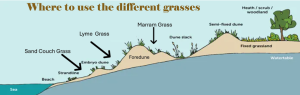
Restoring the Front Edge of Dune Systems with planting. (see photos of real examples at bottom)
The most common dune restoration issue is where the embryo and foredunes (see above) have been lost and the sea is eating into the tall maram-covered dunes at the rear of the orignal dune-line. The following diagram gives an idea of how to restore the embryo and foredune layers.
The different types of plants needed to recreate these layers are detailed in the next section.
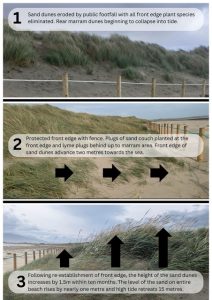
Recreating the embryo and foredune layers
Key Dune Forming Coastal Grasses
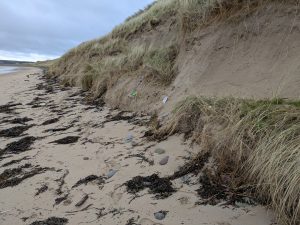
Typical situation across Ireland where the embryo and foredunes are lost to footfall leaving the less salt-tolerant marram dunes exposed and collapsing
Marram (Ammophila arenaria) is the most common dune-building plant. Erosion at the front edge of the dunes frequently means that the other 2 key plants are not available for transplant or propagation. Marram is not as salt tolerant as Lyme and Sand Couch so is not really suited to the front edge, or growing new dunes.
However it may be best suited to regrowing blow-outs, dune slacks or damaged permanent dunes.
Lyme grass (Leymus arenarius): A taller, blue-grey grass that grows in a narrow strip in front of the main dune system. This layer is called “foredunes”. See diagram at the top of this page. Lyme Is salt tolerant and rapidly builds height in dunes for later colonisation by Marram growing forward from behind as the height of the dune increases..
Sand couch (Thinopyrum junceiforme): Often found on the “embryo” dunes (see diagram at top of page) closer to the high-tide mark is the most salt tolerant and will grow in shingle and sand on the very front edge of the dunes
Sand sedge (Carex arenaria) has a similar growth form to sand couch, although not a grass itself.
Dune Grasses may be used to:
- Regenerate or regrow dunes that have been damaged or destroyed by human footfall, bikes, quads or other human intervention.
- Trap sand at the eroding windward faces of dunes and so help maintain their positions
- Reduce the scouring effect of wind in blowouts and trap sand to help fill them in
- Consolidate areas of loose sand including blowout deposition areas, embryo dunes, newly contoured dune faces and zones of accretion along fencelines.
- Create a storm-proof growing barrier to rising sea levels.
Fencing without planting does nothing to stabilise the sand surface.
Other Beach Plant Species
Once the front edge of the dunes are safely established, after about 2 years, a lot of other plants can be reestablished to broaden the habitat for insects, birds mammals and lizards both behind the front edge of the dunes towards the rear fence of the dunes protection area and in the new dunes.
Examples include sea radish, sea mayweed, sea beet, sea astor, sea sand wort, tree mallow, creeping willow and sand sedge. See contact below for a charity that will propagate these for you.
Transplanting Grasses
Transplanting in most areas is the cheapest and most effective way to establish species of dune building grasses. However this does cause a problem in that on many eroded beaches, only marram is readily available for transplantation. More salt-resistant species for the front edge of the dunes are not so readily available. Thus Lecale Conservation works with the County Down Charity ‘True Harvest Seeds’ to propagate that other dune grasses on a large scale – see contact details below.

DUNE BUILDING SPECIES
The most useful species to plant on bare sand and to initiate new dune development are the three natural dune-forming perennial grasses: sand couchgrass, sea lyme grass and marram. Marram is most widely used but the other two are preferable when repairing the front edge of dunes. All have the ability to slow the wind and trap sand without causing scour. They have the ability to grow through and accumilate new deposits.
Sand Couchgrass
 Sand couchgrass or sand twitch (Elymus farctus syn. Agropyron junceiforme) is almost universal around the coasts of Ireland and Britain wherever there is moderate sand blow. It is the usual pioneer of embryo dunes since even as a seedling it stands salt and can grow within reach of the high spring tides. Its extensive rhizomes creep through the sand and send up new aerial shoots when buried, as long as the annual sand accretion is under about 300 mm (1′). If sand blows out from around the plant it continues to grow on the surface, protecting it from further erosion by a network of rootlets and shoots. The shoots and rhizomes tend to get tangled up when the plant is lifted, which can cause problems when transplanting. Sand couchgrass shoots are bluish-green and form loose clusters. The leaves are 100–350 mm (4″–14″) long with upper surfaces which have close parallel ribs and many rows of short hairs. The leaves curl inward in dry conditions.
Sand couch rhizomes grow almost without limit horizontally but not vertically. The plant prefers mixed sand and shingle to pure sand. These factors mean that sand couch dunes are characteristically low and broadly domed. Such dunes resist wind erosion well, but where more height is required sea lyme or marram must be used to continue the dune-building process
Sea lyme grass
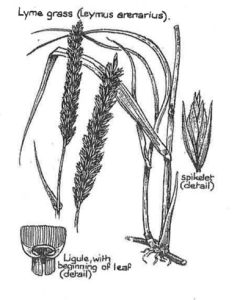 Sea lyme grass or lyme grass (Leymus arenarius syn. Elymus arenarius) is widespread around the coasts of Ireland but is most common in the North and East, where it may be locally abundant. Elsewhere it is likely to be in short supply compared to the other two dune-forming grasses owing to its habit of growing at the front of the dunes and thus being affected by human footfall far more than for marram which grows further back.
This restricts its availability for transplanting, but Lecale Conservation have been working with local charity https://trueharvestseeds.org/ who have perfected growing from seed to order using seed local to each site. As a result sowing may be the best approach to obtain large amounts of Lyme.
Sea lyme has a high salt tolerance. It usually forms a fairly narrow strip above the pioneering couchgrass on the windward side of foredunes. Its tolerance to sand burial is similar to that of sand couch, but it is a much sturdier species in appearance, with stout rhizomes which produce clusters of large, sword-like bluish-green leaves 600 mm–1.5 m (2′–5′) high. The upper leaf surfaces are rough due to slightly raised parallel veins while the under surfaces are smooth. The stems are stiff, upright and smooth. It is excellent for stabilising dunes.
Sea lyme grass spreads vegetatively via horizontal rhizomes and, like sand couch, it tends to form broad humpbacked dunes. Once established, it can extend itself farther seaward much better than marram but can be wind sensitive and so flourishes mainly in moderately sheltered locations.
In winter it loses its leaves and offers little resistance to the wind. Thus it is recommended that it be planted behind sand couch grass and in front of marram rather than alone.
It has spread spontaneously and rapidly under natural conditions in many parts of Scotland where it seems as disease resistant as marram and more effective at the seaward edge of dunes. Transplanting experience on the East Lothian coast and on Anglesey bears this out, while in Northumberland it has been found to have a much faster initial growth rate than marram in favourable locations.
Marram grass
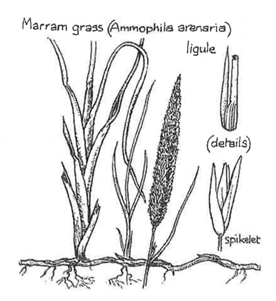 Marram (Ammophila arenaria) is the most common dune-building plant in Ireland, probably because it is available, being the last dune plant to be lost to erosion from human intervention on most beaches.
Unlike Lyme and Couch grass it can build tall dunes but is not as salt resistant and therefore not ideal for the front edge of the dunes.
The closely-related A. breviligulata is throughout the world where conditions are suitable for really high coastal dunes. In certain localities, a hybrid occurs between marram and wood small-reed (bush grass, Calamagrostis epigejos). This is Baltic marram grass (Ammocalamagrostis baltica), which is even more vigorous than marram but is completely sterile and so can only be propagated vegetatively.
No other plants have the ability to grow without limit not only horizontally but also upward through blown sand.
In fact, marram positively requires blown sand to thrive. Once it is sheltered from further sand accumulation, it gradually dies back and reduces its flowering.
As dunes move towards the sea and less sand is blown to the rear, marram is gradually replaced at the rear by heath, bushes and coastal grasses.
Unlike sand couchgrass, marram prefers to spread its rhizomes in pure sand, sending clusters of roots downward while the young shoots grow straight up. As sand accumulates around the shoots, marram forms adventitious roots at higher and higher levels, thus continuing to dominate the dune and make it higher.
Marram just withstands burial by up to 900 mm (3′) of sand in a year provided its leaves are no more than half buried in any gale period and that there is time for the leaves and growing points to reach the new sand level between gales.
On the East Lothian coast, local experience is that marram survives up to 1.2 m (4′) burial at any one time. This is clearly a critical factor in its success when transplanted in areas of loose sand. In any case, its density declines rapidly if very high levels of sand blow persist, as is likely on the higher lee slopes of dunes where marram establishment may be more difficult than elsewhere. To some extent the system is self-regulating, as once marram is buried nothing remains to cause further sand accumulation, until the marram starts to grow through again.
Marram has parallel-veined, light yellow-green leaves, 600–900 mm (2′–3′) long, which remain tightly rolled except in very wet weather. It can be confused with sand couchgrass when young, or with sea lyme grass when well developed, but unlike these it has a particularly long ligule, 10–30 mm (½–1¼″) in length, at the inner junction of the leaf-sheath and the blade. This can be seen at all stages of growth.
Marram tolerates at most 1% salinity, according to Adriani and Terwindt (1974) so it only grows in areas out of reach of the tides. Once established, it is very drought resistant. In the initial colonising phase of its growth it produces few flower spikes, but when well established, it flowers freely and its clusters may spread until they occupy ten or twenty times the original volume of sand. In favourable conditions.
It takes about eight years for the grass clumps to gradually coalesce to form a continuous open sward (Hewett, 1970, p664). In the postoptimal phase, when fresh sand supplies are cut off, it may persist for many years but gradually gives way to other plant species as it dies back.
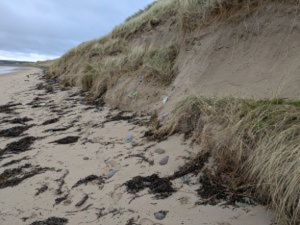
Marram Dunes undercut after losing foredune layer
Marram dunes tend to be steeper and higher than those of sand couchgrass or sea lyme. Where the forward face becomes too steep because of the loss of foredunes, it may be undercut.
In this case clumps of grass slide to the bottom of the slope. Often the clumps re-establish themselves if not inundated by the sea as marram is less salt tolerant than sand couch or lyme. Much loose sand drifts onto the lee slope so that the dune tends to move slowly downwind.
This process is accentuated by marram dunes trapping more sand in their lee so that new shoots grow up most vigorously in this heavily sanded ‘shadow’.
Creating foredunes protected by fencing with more salt-resistant plants like sand couch or lyme will prevent marram dunes being undercut and the semi-permanent marram dunes will grow towards the foredunes and the new fence.
Sand sedge
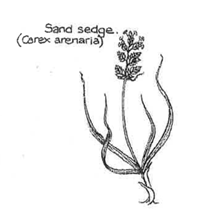 Sand sedge (Carex arenaria) has a similar growth form to dune grasses, although not a grass itself. In some places, e.g. Braunton Burrows, Devon, it helps to stabilise very gritty sea-facing eroding slopes where it withstands the battering of blown grit better than marram. Usually, it grows in dry slacks, where it spreads over the surface via straight runners to form a loose network, occasionally colonising the sand slopes to either side. Although it only grows a few inches high, it might prove useful for stabilisation work provided it could be successfully transplanted.
TRANSPLANT AND STORAGE OF MARRAM
(also applies to Couch and Lyme where available)
Sand-trapping grasses are remarkably tolerant and often survive transplanting even under seemingly adverse conditions. There are a few seasonal considerations which, if followed, allow the greatest success rate. Note that these recommendations come from Britain and we can expect the weather to be more temperate here in Ireland:
- Take and transplant offsets during cool weather. If the average maximum air temperature rises above 15°C during the first three days after planting, few offsets are likely to survive (Hewett, 1973, p58). If possible, carry out transplanting in the season of relative dormancy. This means, broadly speaking, September to April (November to April in the South West).
- In general, planting is most successful in early March. At this time it is also easy to distinguish the living stems of grass by their green colour, so that these rather than dead stems are gathered. (Our experience in Ireland says March after high spring tide and April are OK – as is most of the year if rain is expected and there is no likelyhood of a heatwave)
- Success in other seasons varies greatly in different parts of the country, depending on rainfall. Planting in summer is not successful in the dry east or warmer southern locations, but may be possible in the north-west. On stable and sheltered sites, planting is possible from November to February, but is not worth doing where wind erosion, burial by sand or grazing is going to damage the offsets before they have a chance to establish. The following summary is from Dune Grass Planting (CCS, 1985). The greater number of stars indicates greater success rate.
- Oct–Jan *** Avoid if grazing, burial or erosion is likely in winter.
- February **** Good time to plant if conditions bearable for planting comfort. Avoid frosts.
- March ***** By far the best for all sites. (our experience says after spring tide or a lot of new plantings may be lost)
- Apr–May ** Dependent on cool spring weather.
- June–Sept * Avoid on east coast; moderate success on north or north-west coasts.
- 4. Mid-summer planting may succeed given a spell of cool weather, provided that the work is done carefully. The usual advice is to dig and transplant offsets on the same day. If there is any delay, keep the plants covered in moist sand during the interval before setting out and be sure to plant deep enough so that living roots reach moist sand. Try to avoid disturbing the sand more than necessary since this allows it to dry to deeper levels than would otherwise occur. If you thatch the planted area at the same time as transplanting, the brushwood helps shade the plants and reduces drying of the sand in hot summer weather.
- 5. Experience on the Northumberland coast suggests that marram can be stored up to six months in plastic bags (eg clean fertiliser sacks opened at their narrow end), and that storage for three months causes the nodes of the plants to swell and develop, resulting in faster growth after planting (Ranwell, 1975, p8). Pack the bags loosely and keep them in a cool place, sheltered from the sun, for storage.
WHERE TO PLANT DIFFERENT SPECIES WITH PHOTOGRAPIC EXAMPLES
Here are photos from the Ballyhornan Beach #2 project where the original dunes had been totally destroyed by quads, motorbikes and uncontrolled access.
Prior to planting, a rear fence was built by the Council to direct beach users to one of 2 beach entrances that had been reenforced with zigzag palings. Before attaching the front edge fence, or finishing the chestnut palings, the 3 zones of planting were put in place and the fencing was finished after planting. (It is hard to climb over the fences at first until the sand level rises again)
zone 1 – shingles with some sand where dunes had completely gone – Plant couch grass

couch zone shingles with some sand – to create embryo dunes

Couch to the front lyme to the back
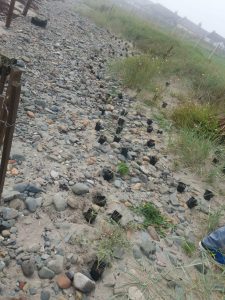
Sand Couch Lyme boundary
zone 2 – bare sand with some rocks where dunes had completely gone – plant lyme grass
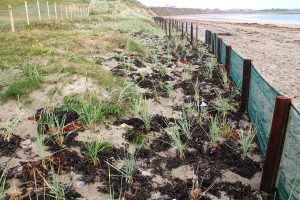
Lyme zone

Lyme Zone just out of shingles to build new front edge dunes
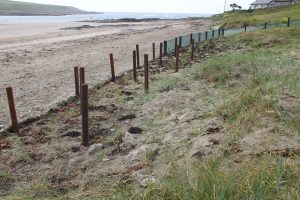
regrowing dunes planting before fencing – lyme to front marram to back
zone 3 – pure sand areas where dunes were damaged or had only recently gone – plant marram grass
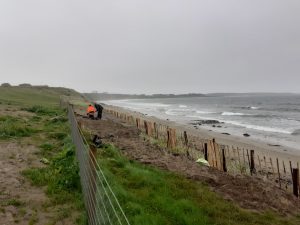
sandy area for marram to regrow recently lost dunes
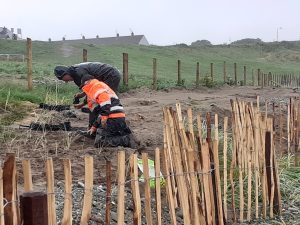
marram to the rear in sand
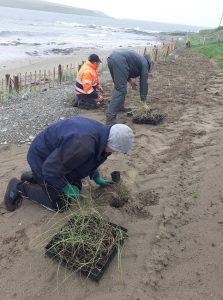
Lyme Marram boundary

Lyme at front edge of the palings and marram behind the palings
zone 4 – blow-outs creating large gaps in the dunes with lots of sand left – plant marram grass and protect with fencing or rope and signs.
BUT if the blow-out is very serious, like the situation below, then Lyme Grass and sand couch dunes may need to be established to the front of the blow-out to raise the level of the beach and protect the marram plantings behind.
In the example below a toilet block built in the middle of the dunes attracted a large amount of footfall and created a giant ‘blow-out’ in the dunes.
A zig-zag chestnut paling box was built forward of the blow-out at the normal high tide mark and planted with Lyme and Couch grass to re-establish a giant protective screen of 8 to 10ft Lyme grass dune in front of old visitors’ centre. This raised the level of the beach in the area to prevent regular salt-water indunation of the dunes behind.
Then the toilet block was removed and the whole area of the blow-out was roped off and the 2 sides and rear areas planted with marram. See photos before and after
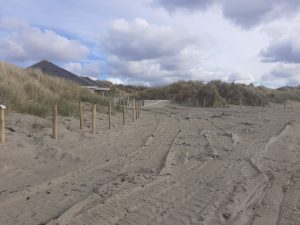
old visitor at Tyrella before
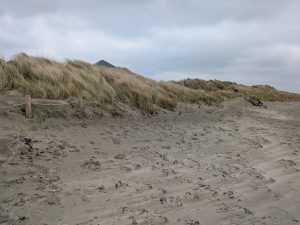
old visitor Tyrella after