REAR FENCING AND PUBLIC NOTICES
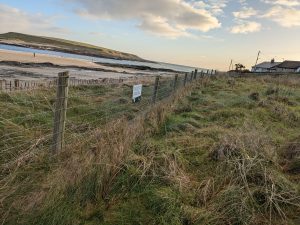 The important first step in any dunes restoration is protecting the rear area of the dunes and directing leisure users to controlled beach entrances. A standard non rust sheep fence with a non-rust tensioning wire along the top is recommended and periodic heavy stay posts.
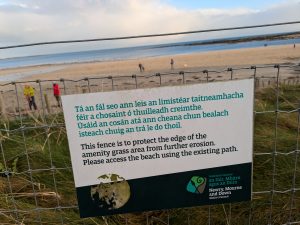
Public support is important for success. 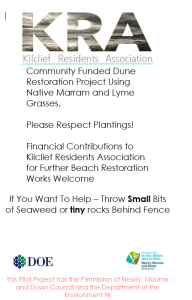 Explaining the reason for the fence will get 90% of beach users on board. If the local village association or residents group is involved it creates more support for the idea. At least 6 months pro-active maintence is recommended as there will always be a minority that does not want to use the new beach entrances at first and repairs will need to be made.
PROTECTING GROWING FRONT EDGE OF DUNES
Depending on beach and its user base, two types of front edge fencing are possible.
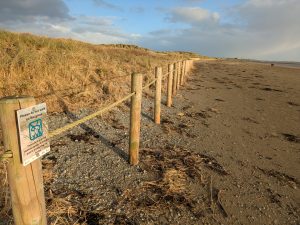 MINIMALIST. A cheap rope fence using lots of small notices to get the public on board. It is a good idea to ask the public to throw bits of seaweed over the rope or behind the fence as this does help trap sand and gives nutrient to new growth.
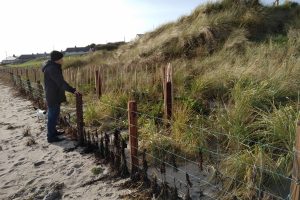
CONTROLLED. A sheep fence with rust-proof tension wire like the rear dune fencing like the exaple at the top of this page can be used to physically keep the public out of the dunes. But stronger and longer treated posts and stay posts should be used. Note the fence in this picture was shoulder-height – the level of the beach has risen 3 feet. See this picture>>
In front of palings. A ‘controlled’ or sheep fence at least 1 meter in front of sections of zig-zag pailings is also essential as it allows for sand couch or lyme grasses to build up dunes rapidly around the pailings in the absense of human footfall. This allows sand to rapidly accumilate and ‘dissapear’ the pailings under tall new dunes.
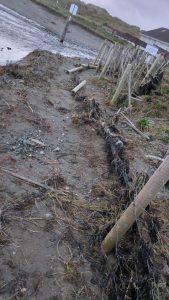
Cheap posts snapped off in first storm
Difference in post performance and price. The posts we use are dipped for 16 weeks in preservatives to stop the rot ( same as the electricity poles). They have a 25 years plus life time and are 2.3 meters long so can be pushed fruther into the ground. They are much stronger and are very unlikely to snap.
Our local Council uses 1.8 meters long posts which are copper sprayed and rated with a 5 years life span. They are about 1/3 the price but can snap in storms and be uprooted esily and rarely last the 5 years in a salt environment.
ARMOURING CONTROLLED ENTRANCES TO BEACH – using ‘zig-zag’ chestnut palings
Chestnut palings, properly installed, create 8 foot tall storm resistant dunes within 18 months on any part of the beach. Those areas needing extra attention like controlled beach access areas are ideal for this method.
This approach turns the weak points in the dunes into strong points. Unprotected beach entrances can turn into giant blow-outs losing acres of dunes behind the front edge of the dunes. These blow-outs will also eat away the front edge of the sand dunes fruther in each direction with every high tide.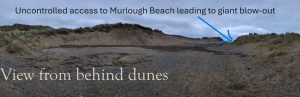
Here is a dramactic example of this at the National Trust owned beach at Murlough in County Down. Here a failure to manage beach entrances and the front edge of the dunes is leading to massive losses compared to nearby Tyrella beach that has higher visitor numbers.
Never put chestnut pailings in a straight line. Always use a 90 degree zig-zag!!
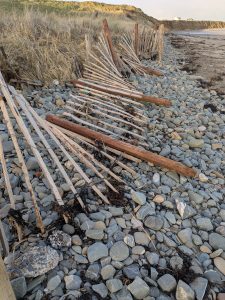 The 90 degree zig-zag slows the wind and grows dunes rapidly. They also better survive contact with heavy waves, storms and high tides, especially where the right type of posts are used (see ‘Protecting front edge of dunes’ above).
Putting pailings in a line opposite the waves will result in losing them along with any plantings in the first storm. As the line of the waves is not broken and the full force of the waves is felt going in and out, scouring with every wave. Also, the palings will collect no sand as the wind effect only works with the 90 degree zigag pattern with 50% porosity.
-
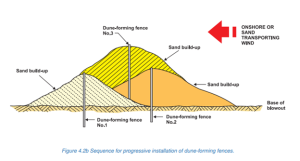
Successive layering of Chestnut palings will allow dunes to mimic their natural ‘march’ to the sea with the front edge protected.
Sand Trapping: The “zig-zag” (or “V” and “U” shapes) creates localized areas of low wind speed. When wind-blown sand hits these pockets, it loses energy and drops, building up a foredune.
- Erosion Control: By trapping sand, these fences fill gaps in dune ridges and protect fragile coastal ecosystems from being washed away.
- Energy Dissipation: Unlike straight fences, the zig-zag layout breaks up the direct flow of wind and water, preventing “tunnelling” effects that can accelerate erosion.
Installation Guidelines
-
- Post Placement: Install treated chestnut posts at every “peak” and “valley” of the zig-zag (every change of direction).
- Burial Depth: Posts should be at least 2 meters long, with at least 1 meter buried below the beach level to provide stability against shifting sand and wind pressure.
- Porosity: Chestnut palings should have approximately 50% porosity (the gap between pales should equal the width of the pales themselves). This ratio is most effective for reducing wind speed without causing excessive turbulence.
- Tensioning: The wire-bound palings must be pulled tight and stapled to the posts to prevent sagging or “bellowing” in the wind.
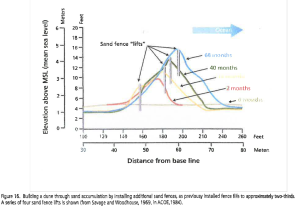
It is possible to estimate the time and investment needed to naturally restore a new front edge to sanddunes
REPAIRING MAJOR BLOW-OUTS
The images below demonstrate how to repair a large blow-out following erosion triggered by large numbers of visitors to a beach where the front edge of the dunes and dune entrances are not protected or controlled.
Phase 1 – using palings (as per last section above) to protect both sides of blowout and create a new ‘plug’ of 8 or 9 foot dunes in the centre.
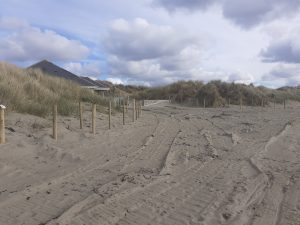
BEFORE Showing preparation for zig zag palings on both sides of blowout to stabilise old entrance. Giant central new dune also grown at centre.
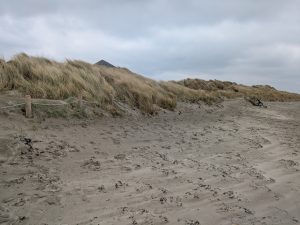
AFTER Palings buried by 8 to 10 foot new dunes. one giant dune grown at front centre of blowout and boths sides of blowout armoured with palings.
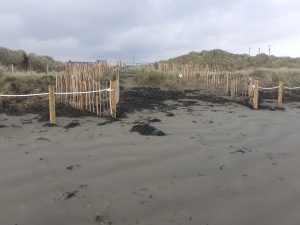
new entrance being armoured with chestnut palings

NEW ENTRANCE AFTER – with chestnut palings vanishing under new after only 7 months
Phase 2 shows front line of beach being moved forward and 2 sides of blowout joined to new central dune by rope fence with notices requesting public to use new entrance.
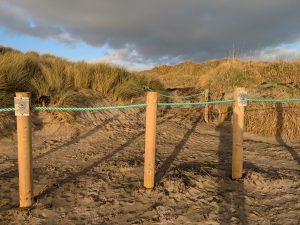
Showing beach line being brought forwad and old entrances blocked off by rope and notices to public to use new armoured entrance
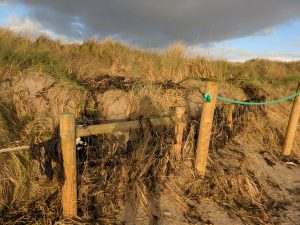
Showing how palings on both sides of blowout and central new giant dune have vanished under new dunes up to 10 foot high
SHOULD OLD FENCING BE REMOVED?
As can be seen from the photos and diagrams above. The idea behind zig-zag palings is that they should vanish. Forever. Creating the core of dunes that can be ‘marched’ towards the sea, or built into even higher dunes by successive layers as is done in come coastal areas like the Netherlands where dunes of 30 meters in height are not uncommon. Therefore removing this fencing is likely to destroy this restored habitat.
However, removing, maintaining or renovating the ‘front edge fencing’ or particularly the ‘rear fencing’ (see top) should be built into the maintenance regime of the land owner or beach manager organisation.
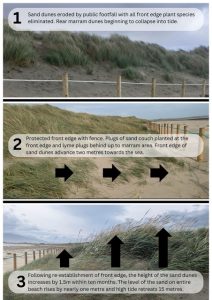
‘Marching’ the sanddunes to the sea. However, that being said, a policy of allowing the beach to slowly ‘march forward’ by a meter or so every few years and protect new front edge plantings or natural growth would elimnate the need to remove old fencing as it would be covered by new inaccessable dunes as explained in the following diagram.
WHY A FIXED FRONT EDGE OF DUNES IS A PROBLEM? Marram grass will grow from the rear as the dune height increases. The marram will also grow forward into where the front layer plants had been growing at a lower height. The front layers of Lyme and Couch grasses or other ‘front growing’ species will want to grow forward too, until they meet human footfall where they will die. At this point, the marram grass will grow to the front of the dune, squeezing out the front growing species.
The result will be a tall marram-only dune, that is comparatively salt intolerant, facing onto the waves and high tide. This is a recipie for dunes being under-cut and collapsing into the tide. The diagram below explains how to avoid this by ‘marching forward’. Link to this document is here